How Do I Add Levels and Progression to an AI Game Easily
One of the fastest ways to make an AI generated game feel complete is by adding proper levels and progression. Without them, even a fun core mechanic can become boring after a short time. Players want to feel they are advancing, unlocking new things, and facing fresh challenges as they play. The good news is that you can add levels and progression to your AI game without complex coding. Smart tools make it possible to create structured stages and meaningful growth with simple descriptions and adjustments. This guide explains easy methods to build levels, increase difficulty, add rewards, and create a sense of steady progress that keeps players motivated.
Why Levels and Progression Matter
Progression gives players a clear reason to keep playing. When they can see themselves getting better, unlocking new content, or reaching higher stages, they feel a sense of achievement. Without progression, the game feels like an endless loop with no purpose. In AI-generated games, progression is especially important because new content can feel random. Well-designed levels turn that randomness into structured advancement. Players enjoy seeing new environments, facing slightly harder challenges, and earning rewards that make them stronger or the game more interesting. A good progression system keeps the game fresh while still feeling fair and achievable.
Four Key Elements of Good Progression
Successful progression in AI games usually includes these four important parts.
- Clear Level Structure: Create distinct stages that gradually increase in difficulty and introduce new ideas.
- Increasing Challenge: Make each new level slightly harder than the last through faster enemies, more obstacles, or new mechanics.
- Unlockable Rewards: Give players new abilities, characters, skins, or power-ups as they complete levels.
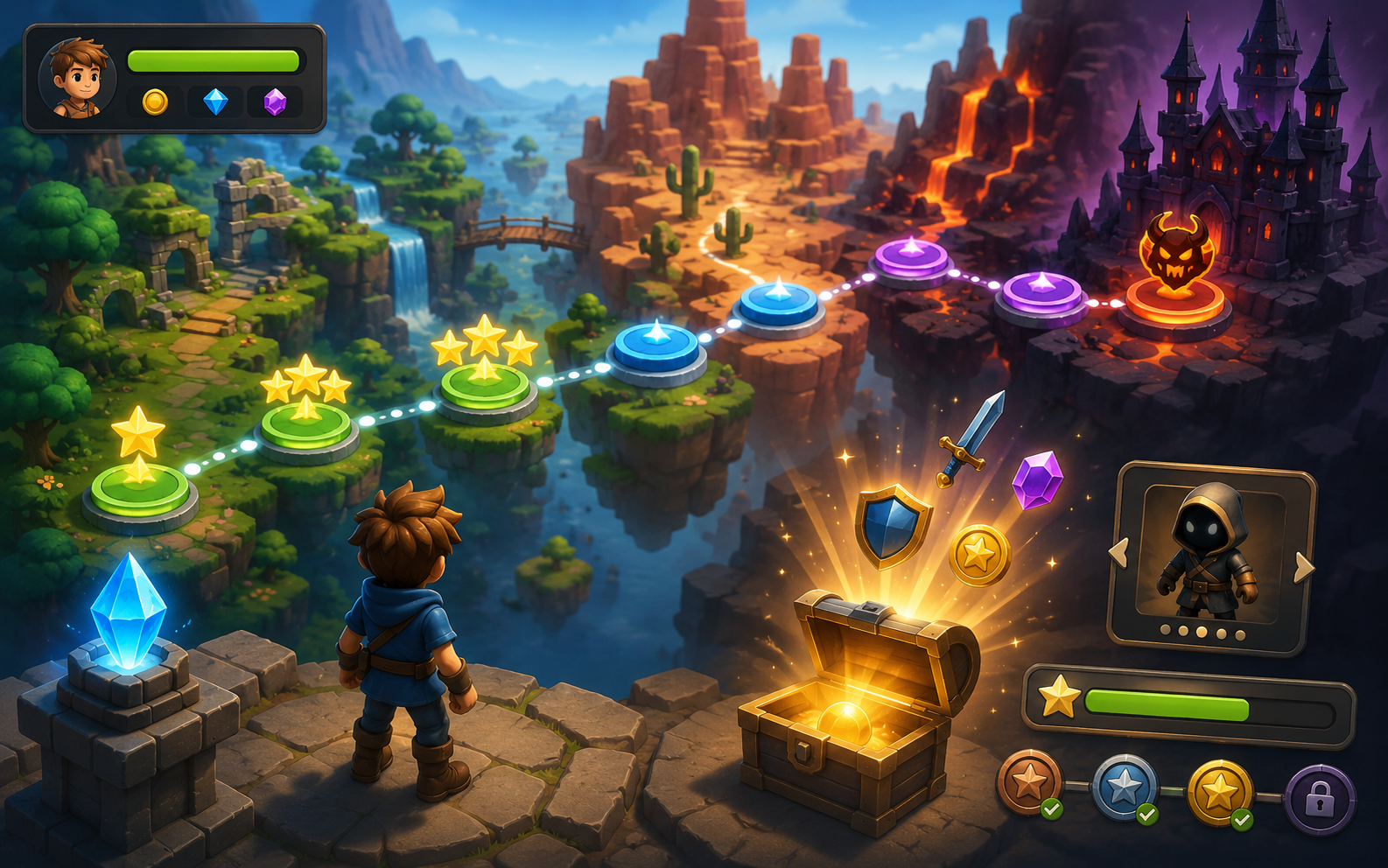
- Visible Progress Markers: Show players how far they have come with level numbers, stars, or progress bars.
Creating Your First Levels
Start by designing a simple first level that teaches the core mechanic. Keep it short and easy so new players can succeed quickly and feel confident. For the second and third levels, introduce one new element each time, perhaps a new type of obstacle, faster movement, or a simple puzzle. Gradually increase the number of challenges while keeping the core controls the same. In AI-generated games, describe your levels clearly to the tool.
For example, ask for a level that adds moving platforms or requires faster reactions. Test each new level immediately after creation and adjust the difficulty until it feels right. A great example of well-structured levels and progression can be seen in Pickaxe Palooza. You can try it on Astrocade. Notice how each stage introduces something new while building on the previous ones.
Adding Meaningful Rewards and Unlocks
Rewards make progression exciting. After completing a level, give players something tangible, a new character skin, extra lives, a temporary power-up, or points toward a bigger unlock. Create a simple upgrade system where players can spend earned points on small improvements such as faster movement or stronger jumps. This gives them a feeling of control over their progress.
For AI-generated games, set rules so that completing certain milestones automatically unlocks new content types for future generated levels. This keeps the game feeling fresh without manual work for every stage.
Four Practical Ways to Add Progression Easily
Here are four straightforward methods you can use right away.
- Sequential Level Design: Build levels one after another, making each one introduce a new challenge or mechanic.
- Difficulty Scaling: Increase speed, number of obstacles, or complexity gradually as players advance through the stages.
- Milestone Rewards: Unlock new features, visuals, or abilities after every few levels.
- Progress Tracking: Add a level select screen or world map that clearly shows which stages are completed and what comes next.
Making Progression Feel Fair
Good progression should feel challenging but never impossible. Early levels should be forgiving so players learn the game comfortably. Later levels can be more demanding as long as players have the tools and knowledge to succeed. Test your progression with both new players and experienced ones. New players should be able to complete the first few levels easily, while more skilled players should find later stages satisfyingly difficult. Adjust the difficulty curve based on real feedback. If too many players get stuck at the same level, make small reductions in difficulty or add extra help in that section.
Keeping Players Engaged Long Term
To prevent players from losing interest after unlocking everything, add light replay value. Include daily challenges, score targets, or special modes that become available after completing the main progression. You can also create multiple paths or difficulty modes so players can replay earlier levels with new goals. This extends the life of the game without requiring you to build hundreds of new levels manually.
In AI generated games, use progression rules that encourage the system to create increasingly complex content as the player advances. This keeps the experience feeling alive and expanding.
Testing Your Progression System
Play through the entire set of levels yourself multiple times. Check whether the difficulty rises smoothly and whether each new stage feels like a natural step forward. Ask other people to test the progression from the beginning. Watch where they get stuck or lose interest and make adjustments accordingly. Good progression should make players want to see what comes next.
Wrapping Up
Adding levels and progression to an AI game is much easier than most people think. By creating clear stages, gradually increasing difficulty, offering meaningful rewards, and tracking player progress, you transform a simple game into one that feels complete and addictive. Whether you build your games with Astrocade or other easy tools, these methods help you guide players through a satisfying journey of improvement and discovery. Start small with just a few levels, test them thoroughly, and expand from there. With steady progression and well-placed rewards, your AI-generated game will keep players coming back to see how far they can go. The sense of advancement is what turns casual players into dedicated fans who enjoy your game for weeks or months.